Impaired driving remains a significant public safety concern in Canada with an estimated one-third to half of all motor vehicle fatalities involving a driver who had consumed alcohol or drugs. Since the legalization of cannabis in Canada in 2018, impairment through cannabis consumption is an especially growing problem. To understand how substances affect driver behaviour, CAMH was one of the first Canadian institutions to acquire a high-fidelity driving simulator. Over the past 15 years, the Driving Simulation Laboratory has led numerous first-of-its-kind driving research studies to safely and precisely measure impairment.
Recreating the experience of driving
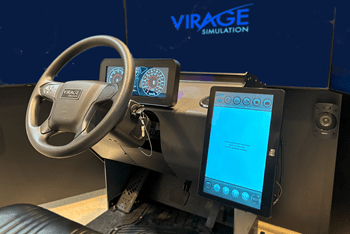
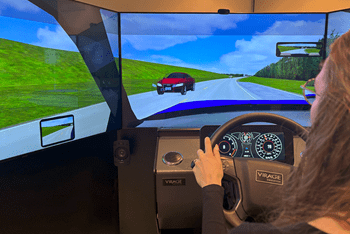
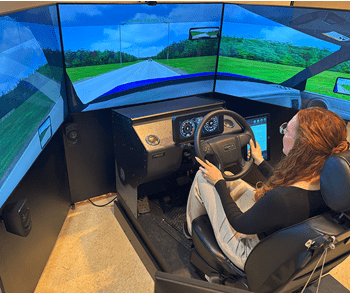
Today, the CAMH Driving Simulation Laboratory contains three driving simulators designed to closely replicate real-world driving. Each simulator features wraparound monitors to mimic the driver’s field of vision, along with rear-view displays that show the view out of the back passenger windows. Although the gearshift has been replaced by a tablet in newer models, the steering column, pedals, and driver’s seat mirror those of an actual vehicle, allowing the research team to capture realistic driving responses in a controlled and safe setting.
“It felt more realistic than I expected, especially having to start the simulator with a car key like you would in a regular vehicle. The large screens around you make it pretty immersive, and you do have to stay focused the whole time. The seat also moves with the driving, which adds to the experience,” a participant recalls of their experience driving the simulator.
Leading cutting-edge driving research
The strength of the Driving Simulation Laboratory lies not only in its technology, but also in its multidisciplinary team. Experts in pharmacology, toxicology, addiction medicine, mental health, psychology, neuroscience, cognitive science, road safety, gender studies, and clinical trial methodology collaborate to investigate the complex effects of substances on driving.
“Driving, particularly alcohol- or drug-impaired driving, is a very multidisciplinary field of study requiring diverse skillsets and knowledge. It’s rare to find such strong expertise across these different disciplines all in one team,” says Dr. Christine Wickens, Senior Scientist at the Institute of Mental Health Policy Research (IMHPR).
Supported by a unique infrastructure—including clinical examination and observation rooms, interview spaces, a pharmacy, and a clinical laboratory—the team has conducted more than a dozen major research studies, secured numerous coveted grants, and published a multitude of high-impact research papers since acquiring its first simulator in 2010.
They were one of the first to study the effects of cannabis alone and in combination with alcohol using modern driving simulation in Canada, and are leading novel research on cannabis-impaired driving in older adults. In addition, they recently secured grant funding to be among the first to study the effects of psilocybin, a psychedelic compound found in “magic mushrooms”, on driving. Ongoing research is also examining how cannabis dose influences driving performance, whether effects differ between occasional and regular users, and how various routes of administration—such as smoking versus edibles—impact impairment.
“Cannabis taken through differing methods has very different effects on the body. The effects of the drug can last for varying periods of time and differ depending on the cannabis usage experience of the individual or the dose they are consuming,” explains Dr. Patricia Di Ciano, Scientist at IMHPR. “Following legalization, we are now also seeing a lot of new types of cannabis products on the market with high-potency cannabis, vapes, and edibles gaining significant popularity. This makes it crucial to investigate how all of these new products affect driving.”
Informing future public policy
The research conducted by the team is building a strong evidence base to inform future legislation on impaired driving and roadside screening, as well as public health guidance—such as recommended wait times after cannabis use before driving and the heightened risks of combining cannabis with alcohol, along the potential risks of newer methods of cannabis use. The team’s expertise is also recognized internationally, with researchers regularly invited to present at conferences and contribute to advisory panels shaping the future of road safety.
“By pairing rigorous, policy-relevant research with the precision of driving simulators—now considered the gold standard methodology for predicting real-world driver behaviour—we can safely and effectively uncover how substances like alcohol and cannabis impair driving, generating the critical evidence needed to guide smarter laws and save lives,” says Dr. Christine Wickens.
As substance use patterns continue to evolve, so too must our understanding of how impairment affects driving. Through innovative technology and interdisciplinary collaboration, the CAMH Driving Simulation Laboratory is helping close critical knowledge gaps—ultimately supporting safer roads and more informed decision-making for all Canadians.
Learn more about the CAMH Driving Simulation Laboratory here

By Centre for Addiction and Mental Health – 20.Apr.2026
Behind the Wheel: Inside Canada's Leading Driving Research Lab
How innovative simulation technology and multidisciplinary research are helping shape safer roads across Canada
- Behind the Wheel: Inside Canada's Leading Driving Research Lab
| Did you know? |
|---|
| Cannabis and alcohol affect driving in different ways. Drivers under the influence of cannabis tend to drive more slowly than when sober, compensating because they know they are impaired, while alcohol-impaired drivers are more likely to speed. Both significantly slow reaction time and can lead to unsafe driving behaviours such as drifting or weaving between lanes—meaning it is never safe to drive under the influence. |
Interested in participating?
Explore our ongoing driving research studies